Following the
route in reverse.
Cemí I, the mask that watched over me, and a journey back through my mother’s story.
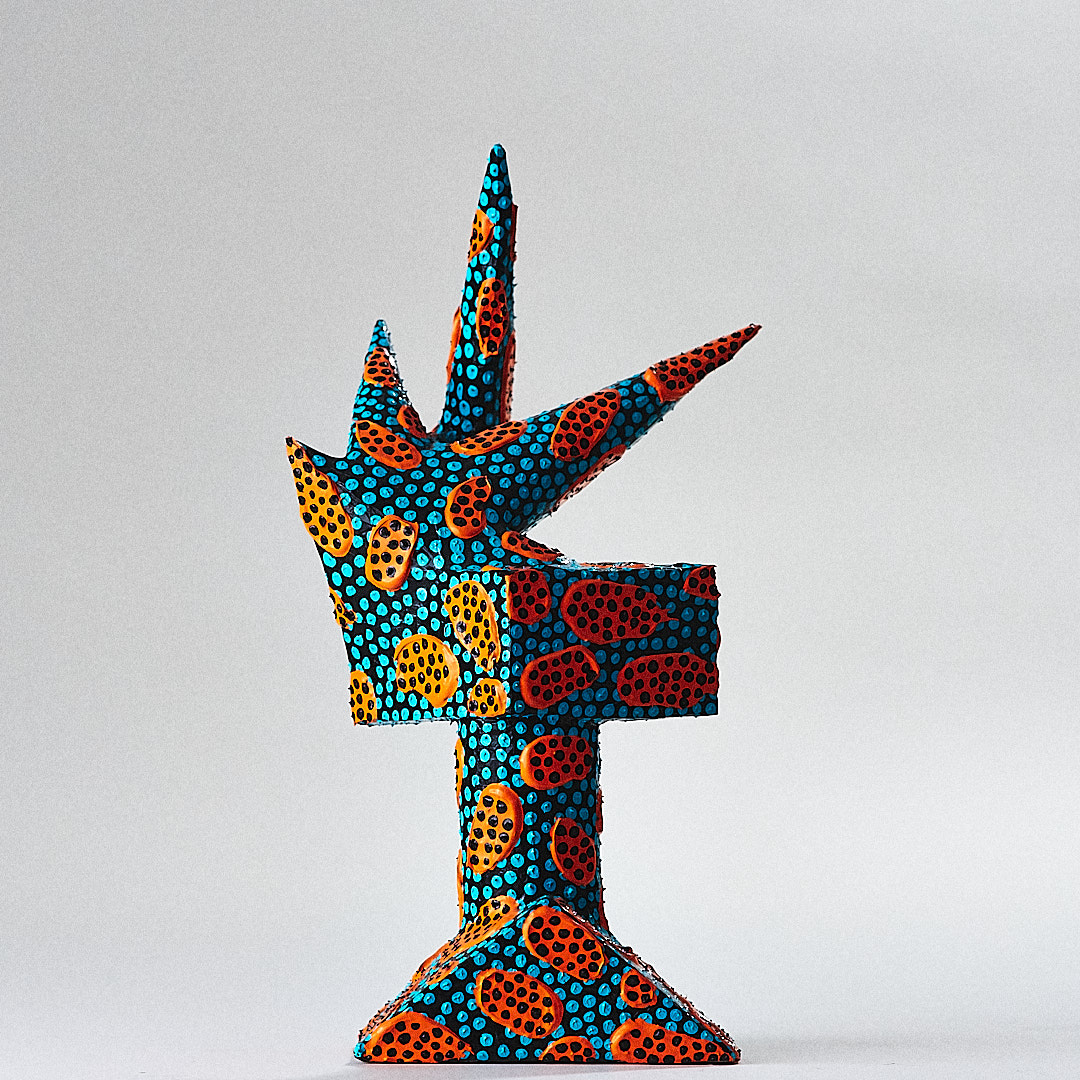
The first thing I brought back was a presence.
On my first childhood trip to Puerto Rico, I chose a vejigante mask and brought it home. It lived in my room. I loved its horns and its colors, but what has stayed with me is the feeling that it watched over me. I had a relationship with it before I had words for what that relationship might mean.
When I look at Cemí I now, I can follow something back to that room. The horns have become their own form. The color moves across the surface. Each dot gives me somewhere to put my attention. A feeling I carried for years has begun to take a shape I can share.
A route I am learning to read
My mother left Puerto Rico at fifteen and moved to the South Bronx in the 1970s, without speaking English. That is her story. I want to understand it through her, through the places she knew, and through the histories surrounding the life she built.
I grew up in the Northeast. My mother speaks fluent Spanish; I did not learn it from her. There are parts of my own family history that I am only beginning to find language for. Learning Spanish now changes the kinds of questions I can ask and the conversations I hope to have.
She traveled away from the island toward a life that became part of mine. I find myself following that route in reverse: through her growth, her movement, and the things that reached me even when I could not name their origins. I came to New York looking for opportunity, too. That gives us a point of connection, while leaving room for the differences between our lives.
I want to know Puerto Rico through the land, the food, the people, the art, the music, and the ordinary things someone might show you when you have time to stay and listen. My work is one way of making that time.
The memory inside the material
The Ponce vejigante mask is a starting point. Its horns, raised surfaces and color have stayed with me. The National Endowment for the Arts’ account of mask maker Juan Alindato describes the papier-mâché and horned forms of the Ponce tradition. Reading about the making brings me closer to something I first encountered as a child.
In my studio, a delivery box becomes an armature. I build with recycled cardboard, cover the form in papier-mâché, and let it harden. Heavy body acrylic begins to give it color and texture. Then I place the dots, one at a time. Another layer of paint may follow, then another layer of marks.
That repeated work asks something of me. I try to be present. Sometimes the mark lets me see that I have wandered off. There is a chance, in the next one, to return. I read my own balance in those small differences: what is happening mentally, physically, spiritually, and how those things enter what I make.
I have long felt a connection with places and objects I encountered in nature, or fashioned myself. Later, reading about Taíno spiritual traditions gave me questions and points of recognition. I am still studying those connections. The mask tradition, my reading, and my personal spirituality each have their own histories; I am trying to understand how they meet in my life.
Sometimes the hand recognizes a connection before I know how to explain it.
Making as a political act
As I follow these connections, I keep returning to decolonization. For me, that begins with examining what I have inherited: the language I speak and the one I am learning, the spirituality handed to me at birth and the practice I chose, the distance from the island and the pull toward it.
Those questions exist within a history larger than my family. Puerto Rico passed from Spanish to United States control in 1898. The Library of Congress’ Puerto Rico research guide offers one place to begin following that history and its relationship to language and identity.
I am interested in what art can do within that history. To make from a connection I feel, to investigate it, to decide what I carry forward: I understand those actions as a form of political protest. The decisions happen in the materials as well as in the words. There is a freedom in shaping something according to a spiritual life I have chosen for myself.
Intuition brought me here. Research gives me ways to question it, deepen it, and enter conversations with other people. I want both to remain active. I want to be changed by what I learn.
A place to keep the conversation
That is what I want Atelier Mattei to hold: the work, the studies, the language learning, the travel as it happens, and the people I hope to meet along the way. These entries will follow a documentary and a body of writing as they develop. This small film is already part of that process. The sculpture, footage, Spanish voice, captured sound, synth music and edit are all mine.
I want the artwork to find homes. I want the resources to keep making it. And I want a community in which these questions can be lived with and talked about. There is a kind of survival in being understood by another person. That matters deeply to me.
If there is an object you have carried with you for years, I would love to hear about it. What has your relationship with it become?
Henry
A moving study
Cemí I.
In my own voice.
Spanish, sculpture, sound and a little synth music. An early piece of the visual story I’m learning to tell.
Sculpture, filming, voice, sound, music & editing by Henry Mattei. Original audio.
Explore the sculptureOn the reading table
Sources & starting points
These references support the historical context. The memories, spiritual interpretations and questions in this entry are my own.
- Juan Alindato — National Endowment for the ArtsOn the Ponce papier-mâché mask-making tradition.
- Puerto Rico Research Guide — Library of CongressHistorical context and routes into language, culture and family research.
Let’s keep talking
What object
has stayed with you?
I’d love to hear its story, and yours.